
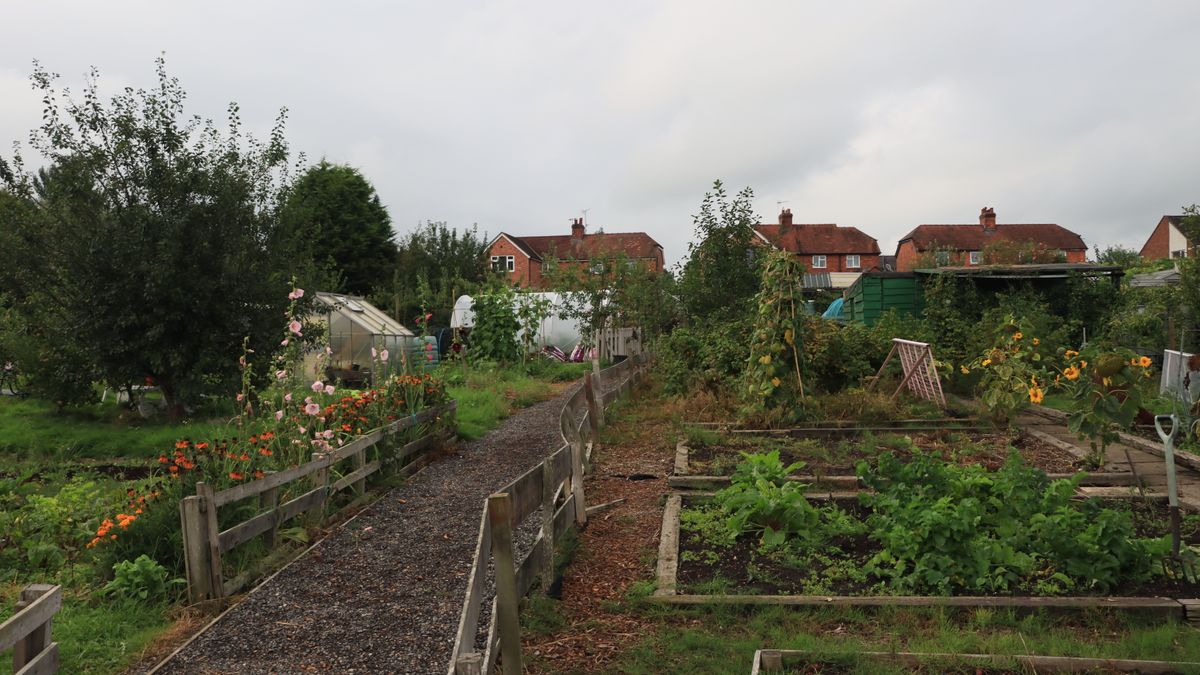
Before you buy a single pot, spend half an hour with a tape measure and a notebook. Tiny gardens reward planning more than any other kind, because every centimetre you misjudge is a centimetre you will feel every time you squeeze past the washing line. Measure the width and depth of the plot, note which way it faces, and mark on your sketch where the sun lands at midday and again in late afternoon.
Then write down what you actually want from the space. Be ruthless here. A garden that is 4 metres by 3 metres cannot be a lawn, a dining room, a vegetable patch and a play area all at once, but it can be two of those things done properly. Choose your priorities and let them shape everything else.
Vertical space is the great unused asset of a narrow plot. A plain fence panel can hold trellis, and trellis can hold far more than most people ask of it. Climbing beans, sweet peas, jasmine, honeysuckle and clematis will all earn their keep, and the right climber can screen an ugly shed or a neighbour's window in a single season.
Wall-mounted systems work well where ground space is precious. A row of troughs fixed at waist height, a stack of wall pots by the door for herbs, or a simple shelf bracket system on a sunny wall can double your growing area. Fix everything into masonry or solid timber, not into the thin edge of a fence panel, and use stainless screws so they survive the winter.
For fruit, consider an espalier or fan-trained tree against a south or west-facing wall. Apples, pears, plums and even figs take kindly to this treatment, and a well-trained tree occupies perhaps 30 centimetres of ground while cropping generously for decades.
In a small garden, every plant has to justify its place. Favour a few strong performers over a scatter of odds and ends. Repeat the same plant two or three times along a border and the eye reads it as a deliberate scheme rather than a jumble.
Mix edibles with ornamentals so the space earns its keep twice over. Chard, cavolo nero and runner beans are handsome enough to sit in a flower border. Herbs such as rosemary, thyme and sage are evergreen, drought-tolerant and useful in the kitchen. Salad leaves grown in a window box or a shallow trough will crop again and again if you pick them young.
Aim for something of interest in every month. A spring bulb layer under a summer perennial, a shrub with good autumn colour, and a couple of evergreens for winter structure will carry you through the year without crowding the plot.
The single biggest mistake in a small garden is a fixed table and four chairs that live outside all year and can never be moved. Go folding instead. A bistro set that folds flat against the wall, a gateleg table that opens only when guests arrive, or stackable stools that double as side tables will give you a dining area that exists only when you need it.
Look for pieces in lightweight aluminium or powder-coated steel rather than heavy timber, and check they can be carried with one hand. A bench with built-in storage is worth its footprint twice over, and a wall-mounted drop-leaf table takes up no floor space at all when it is down.
Think about surfaces too. A small deck or paved area laid in a simple grid reads as calm and uncluttered, and it does not need to be large. Even 2 metres by 2 metres is enough for a table, two chairs and a pot.
Small gardens look twice as big when nothing is lying about. A slimline shed, perhaps 1.2 metres deep, will hold tools, cushions, a mower and bags of compost, and it tucks neatly into a corner that is too shaded for planting. If you cannot spare the floor area, look at a tall upright store for long-handled tools and a lidded bench for everything else.
Use the space under a bench, behind a shed and above a doorway. Hook brackets to the wall for hose reels, trugs and hand tools. Keep a lidded box by the back door for muddy boots and gloves so they do not migrate into the house.
Laying paving or decking diagonally, rather than square to the fence, draws the eye onward and makes a narrow plot feel less like a corridor. A path that curves gently towards a focal point — a handsome pot, a small tree, a bench — works the same way.
Keep the boundary planting low and see-through where you can. A waist-high hedge of lavender or box, or an open trellis, lets light in and suggests the garden continues beyond its actual edge. Mirrors fixed to a shady fence can also lift a dark corner, though they need cleaning more often than you might expect.
Finally, resist filling every gap. A little bare earth or a single sweeping surface gives the eye somewhere to rest, and in a small garden, a bit of breathing room is the most generous thing you can give yourself.

Hi, my name is Anthony kuber. I am artist and fashion designer.
I love to travel and writing blogging.
Your email address will not be published. Required fields are marked *
Software Developer & Writer
Hey, I'm Diva, a developer and writer blending code and creativity. I'm driven by a deep curiosity and a relentless pursuit of excellence. Join me as I craft digital solutions and captivating stories.


