
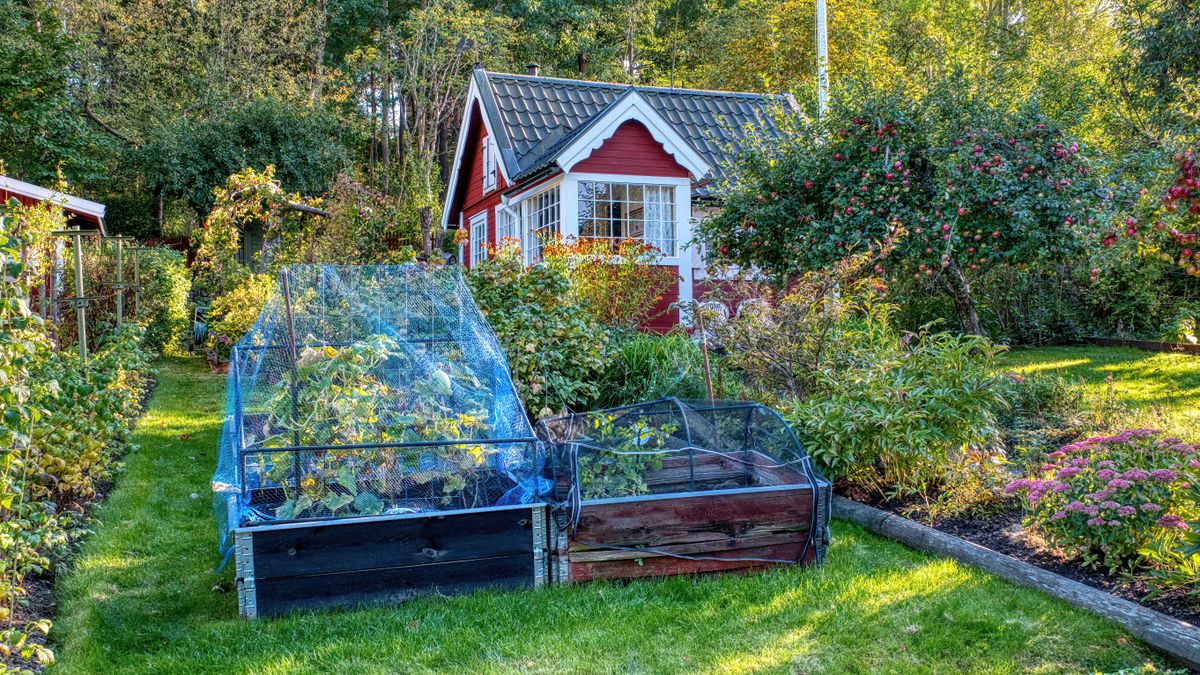
Before you buy a single pot, spend a week watching your garden. Note where the sun falls between 10am and 4pm, where the frost lingers, and which corner turns into a wind tunnel every March. Most kitchen crops want six hours of direct sun, though salad leaves, parsley, mint and chard will manage on four. In a modest UK plot, the north-facing strip beside a fence is rarely worth fighting over for tomatoes — but it will happily give you rocket, wild garlic and a decent crop of blackcurrants.
Measure properly, then subtract your paths. A garden two metres wide will feel generous if you keep a 60cm walking strip down the middle and build beds no deeper than 60cm on either side. That is the difference between a plot you tend weekly and one you resent by July.
A raised bed 1.2m wide by 2.4m long is the classic for good reason: you can reach the centre from either side without stepping on soil. Two of these, plus a narrow trough along a wall, will feed a household surprisingly well.
Containers are not a compromise — they are a tool. They warm up faster in spring, let you move tender plants under cover, and can be positioned exactly where the sun is best.
Vertical growing is how you double your harvest without losing a square centimetre of ground. Fix trellis to a sunny wall or fence and treat it as a productive surface, not just a backdrop.
Soft fruit is the best-value crop for a small garden: it is perennial, it fruits in its own time, and much of it tolerates part shade. Strawberries work beautifully in a stacked planter or hanging basket, where the fruit hangs clean and slugs struggle to reach it. Plant them in early autumn for the best crop the following summer, and renew the plants every three years.
Blueberries need ericaceous compost and rainwater rather than tap water if your area is hard — a single 40cm pot will crop for a decade. Currants and gooseberries are forgiving, tolerate partial shade, and can be trained as a single-stem standard or a low fan against a fence. Autumn-fruiting raspberries are the neatest option for a narrow bed: cut every cane to the ground in February and you get fruit from late August with no tying-in at all.
The real test of a small kitchen garden is whether it still looks after itself in week twelve. A few habits make the difference:
Scale your plan to the time you genuinely have. Two well-tended beds will out-produce six neglected ones, and a garden that gives you herbs, leaves and a bowl of strawberries every evening is a productive kitchen garden by any measure.

Hi, my name is Anthony kuber. I am artist and fashion designer.
I love to travel and writing blogging.
Your email address will not be published. Required fields are marked *
Software Developer & Writer
Hey, I'm Diva, a developer and writer blending code and creativity. I'm driven by a deep curiosity and a relentless pursuit of excellence. Join me as I craft digital solutions and captivating stories.


